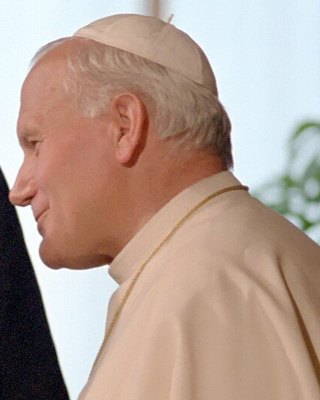
Pope John Paul II led the Catholic Church for more than 26 years, travelled farther than any pope before him, and helped bring an end to communist rule in his native Poland and across Eastern Europe.
Karol Józef Wojtyła was born on 18 May 1920 in Wadowice, Poland. By the age of 21 he had lost his mother, his elder brother and his father. Under Nazi occupation he worked in a quarry and a chemical plant, acted in an underground theatre, and studied for the priesthood in a clandestine seminary in Kraków.
Priest, scholar, bishop
Ordained on 1 November 1946, he earned a doctorate in Rome, then taught philosophy and ethics in Poland, at the Catholic University of Lublin, while serving as a priest among students. He became auxiliary bishop of Kraków in 1958, its archbishop in 1964, and a cardinal in 1967, taking part in the Second Vatican Council.
Pope
Elected on 16 October 1978, he was the first non-Italian pope in 455 years. His first visit home, in June 1979, drew millions; his words "Do not be afraid" and the Mass in Warsaw are widely seen as preparing the ground for the Solidarity movement. On 13 May 1981 he was shot in St Peter's Square; he survived and later visited and forgave his attacker, Mehmet Ali Ağca.
He made 104 journeys outside Italy, began World Youth Day, published the Catechism of the Catholic Church (1992), canonised more saints than all his predecessors of recent centuries together, and asked forgiveness for the past sins of Christians, including towards the Jewish people. In his last years he bore Parkinson's disease publicly. He died on 2 April 2005 and was canonised on 27 April 2014.