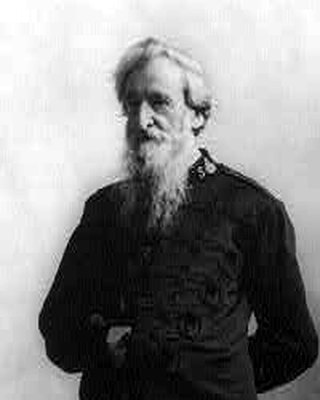
William and Catherine Booth founded The Salvation Army, joining open-air evangelism to practical help for the poorest people of Victorian England — and, within their lifetimes, of many other countries.
William Booth was born in Nottingham on 10 April 1829. Apprenticed to a pawnbroker as a boy, he saw poverty close at hand. He was converted as a teenager among the Wesleyan Methodists, began preaching in the streets, and later became a minister of the Methodist New Connexion. Catherine Mumford was born on 17 January 1829 in Ashbourne, Derbyshire, and grew up a devout and widely read Methodist. They married in 1855.
The Christian Mission
Catherine was a theologian and preacher in her own right. In 1859 she published Female Ministry, defending women's right to preach, and from 1860 she preached herself, often to large audiences. William left the New Connexion to work as an independent evangelist, and in 1865 began preaching in a tent in the East End of London — the start of the East London Christian Mission.
In 1878 the mission took the name The Salvation Army, with William as its General, uniforms, ranks and brass bands. Women served as officers alongside men from the beginning. The Army's meetings were often attacked by mobs, but it spread rapidly through Britain and abroad.
Soup, soap and salvation
The Booths insisted that the Gospel and practical help belong together. The Army opened shelters, food depots and rescue homes, and campaigned against the trafficking of girls. In 1890 William published In Darkest England and the Way Out, a plan of employment bureaus, farm colonies and other relief that shaped the Army's social work.
Catherine died of cancer on 4 October 1890. William travelled and preached until near the end, and died on 20 August 1912, by then leading an Army at work in dozens of countries. Their son Bramwell succeeded him as General; their daughter Evangeline later led the Army as its fourth General.